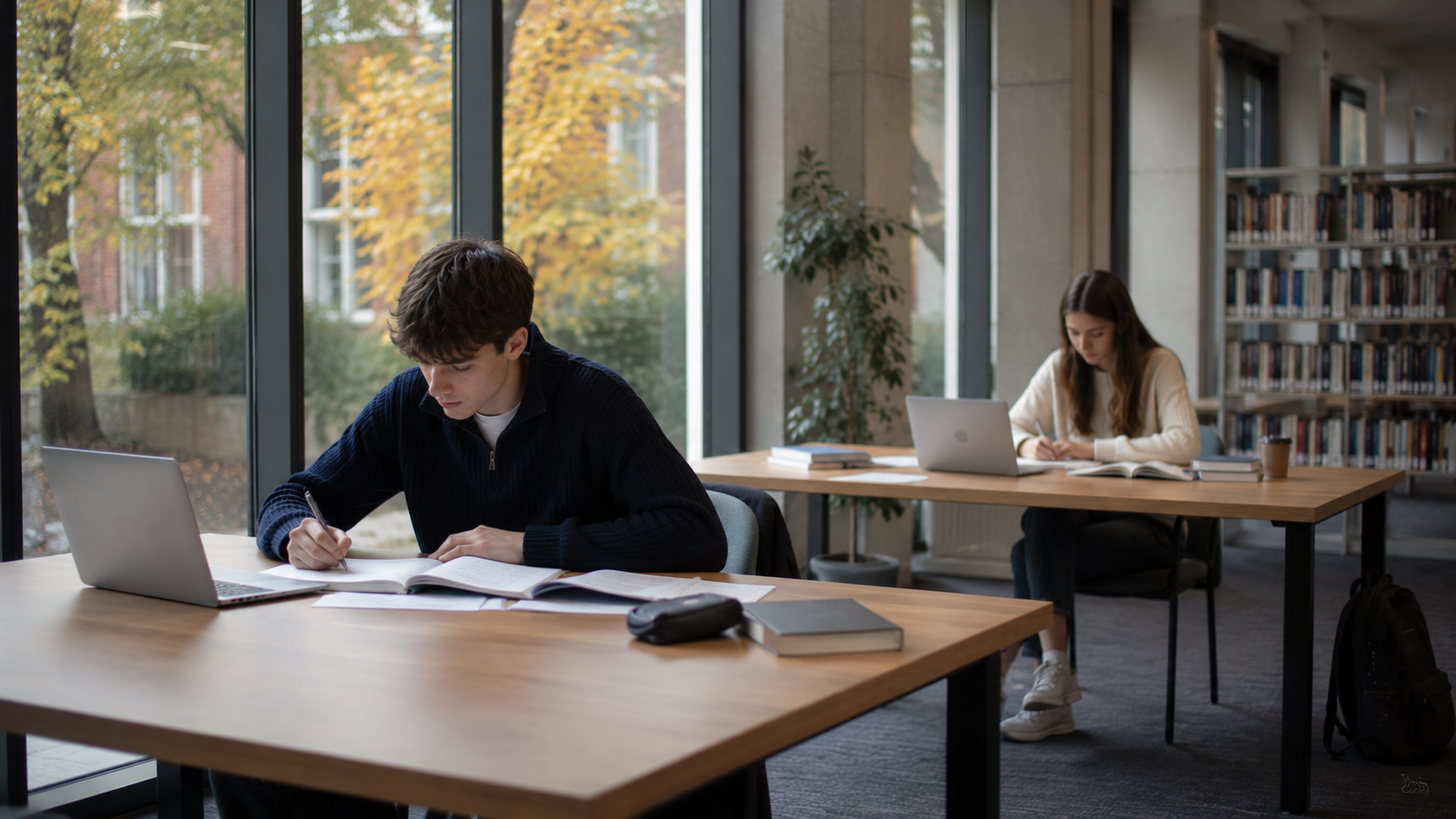
Comparison is difficult to avoid when you are studying. Someone finishes an assignment before you. A friend seems to understand a difficult topic immediately. Another student mentions how many hours they revised at the weekend, while somebody else casually reveals a practice-paper score considerably higher than yours. Even when nobody is deliberately competing, academic life provides plenty of opportunities to measure yourself against other people.
For students using online learning, comparison can take a slightly different form. You may have fewer classmates physically around you, but social media, group chats and online study communities can provide an almost continuous view of what other students appear to be achieving. The difficulty is that these glimpses rarely provide enough information to make a fair comparison. You see somebody else's result without seeing everything that contributed to it.
Occasional comparison can be useful. Other students can provide inspiration, introduce better ways of working and help you understand what strong academic performance looks like. Problems begin when somebody else's progress becomes the standard by which you judge your own ability. At that point, comparison stops providing information and starts consuming confidence.
You Rarely Have the Full Picture
Imagine two students preparing for the same A-level examination. One completes a practice paper and achieves a substantially higher mark than the other. It is tempting to conclude immediately that the first student is more capable.
That conclusion ignores almost everything else.
Perhaps one student encountered similar material previously. They may have spent more time on that particular topic, received additional support or simply had a good day. The lower-scoring student might be balancing study with employment, family responsibilities or several demanding subjects. A single result cannot reveal those differences.
This is particularly important when students compare study hours. Hearing that somebody studies four hours every evening can make your own ninety-minute session feel inadequate, but time alone tells you very little about the quality of the work. Four distracted hours of highlighting and re-reading may achieve less than a focused hour spent answering questions and correcting mistakes.
Students working through several A-level courses should be especially cautious about comparing workloads because subjects differ considerably. The amount of reading, problem-solving, essay writing or practical understanding required will not be identical across every course.
Without context, comparison produces remarkably unreliable conclusions.
Social Media Makes Academic Life Look Tidier Than It Is
Study content can be genuinely useful. There are excellent explanations, revision techniques and communities online, and seeing other students working can sometimes provide the nudge needed to begin.
There is also a highly polished version of studying presented online.
Desks are immaculate. Notes are beautifully organised. Revision begins at six in the morning. Every assignment appears to be completed ahead of schedule, accompanied by a carefully arranged coffee and an impressive collection of stationery. What is less visible are the unproductive afternoons, confusing topics, disappointing marks and evenings when the person making the content did very little at all.
The issue is not that these students are necessarily pretending. Social media naturally selects moments worth sharing. Few people photograph the hour they spent staring at the same paragraph without understanding it.
If study content inspires you, use it. If it repeatedly leaves you feeling inadequate, reducing your exposure is a perfectly reasonable academic decision. Your learning environment includes the information you consume as well as the physical place where you study.
Compare Yourself With Earlier Versions of Yourself
There is one comparison that can be extremely valuable: current performance against your own previous performance.
Keep evidence.
Save an essay from early in the course. Record practice-paper scores. Notice how long particular types of question take. Return occasionally to a topic that once felt difficult and see whether you can now explain it without assistance.
This approach makes improvement visible.
Students developing better study habits sometimes expect progress to feel dramatic, but academic growth is often gradual enough to be difficult to notice from day to day. Looking backwards over several weeks or months can reveal changes that were almost invisible while they were happening.
A student who moves from 48 per cent to 57 per cent on comparable assessments has useful evidence of improvement, even if somebody else is already achieving 70 per cent. The relevant question is not whether you have overtaken that person. It is whether your current approach is moving you in the direction you need to go.
That does not mean ignoring academic standards. GCSE and A-level examinations have defined expectations, and eventually your work needs to meet them. Measuring personal improvement simply gives you a more useful way of judging the journey towards those standards.
Turn Envy Into Information
Comparison often carries an emotion students are reluctant to admit: envy.
A classmate receives an excellent grade and you wish it were yours. Someone appears effortlessly organised while your own timetable keeps collapsing. A friend receives an offer from a university you are worried about reaching.
Feeling envious does not make you a bad friend or an unpleasant person. It can simply reveal something you value.
Instead of staying with the uncomfortable emotion, ask what information it contains. If you envy somebody's organisation, perhaps you want greater control over your own workload. If you envy a strong essay mark, perhaps writing is an area you want to improve. If another student's revision seems effective, there may be something useful to learn from their approach.
You can then turn comparison into curiosity. Ask how they prepared. Look at the techniques they use. Consider whether any of those methods might fit your own study routine.
The goal is not to become the other student. It is to extract useful information without accepting the assumption that their progress diminishes yours.
Academic Confidence Is Built From Evidence
Students sometimes wait to become confident before attempting difficult work. In practice, confidence tends to develop afterwards.
You attempt a challenging question and solve part of it. You write an essay and receive better feedback than last time. You return to a topic that once made little sense and realise you now understand it. Each experience provides evidence that your abilities can develop.
Psychologist Albert Bandura used the concept of self-efficacy to describe people's beliefs about their ability to succeed in particular situations. Academic confidence works in a similar practical way. Experiences of making progress can gradually alter what you believe you are capable of doing.
This is why constant upward comparison can be damaging. If you only look at people currently performing above you, evidence of your own improvement becomes easy to overlook. There will almost always be somebody achieving a higher grade, studying for longer or progressing more quickly.
Confidence becomes more stable when it is grounded in your own evidence instead.
Different Students Need Different Routes
Education sometimes creates the impression that everyone should move at approximately the same speed. Students begin a course together, sit examinations at the same time and receive grades on the same scale. That standardisation is necessary for assessment, but it can obscure how different the people taking those assessments actually are.
One student may be sixteen and studying full-time. Another may be returning to GCSE courses as an adult alongside a job. Some students have considerable family support, while others manage their education largely independently. People also begin with different prior knowledge, strengths and experiences.
Fair assessment does not require identical journeys.
What matters is whether the route you are taking is moving you towards your own objective. If you need longer to understand a topic, take longer where your timetable allows. If another student finds a subject easier, that does not remove your ability to become good at it. If your route into university or another goal contains an extra year, that year is unlikely to matter much when viewed across an entire adult life.
Education is full of people arriving at similar destinations through very different sequences of events.
Keep Your Attention Where It Can Help You
You cannot control how quickly another student learns, what grades they receive or how impressive their revision looks online. Spending large amounts of attention on those things therefore offers very little return.
You can control what you do next.
You can complete another practice question, ask for help with something you do not understand, adjust an ineffective revision technique or begin the assignment you have been avoiding. These actions may feel less emotionally powerful than comparison, but they are considerably more useful.
There will always be students ahead of you in some areas and behind you in others. Academic life becomes easier when those positions stop feeling like judgements about who you are.
Notice other people's success. Learn from it where useful and celebrate it when you can. Then return your attention to your own work.
The student you most need to outperform is not the person posting their revision timetable online. It is the version of yourself who knew a little less, could do a little less and had made a little less progress than you have today.